
What is a Payment Service Provider (PSP) and Do You Need One?
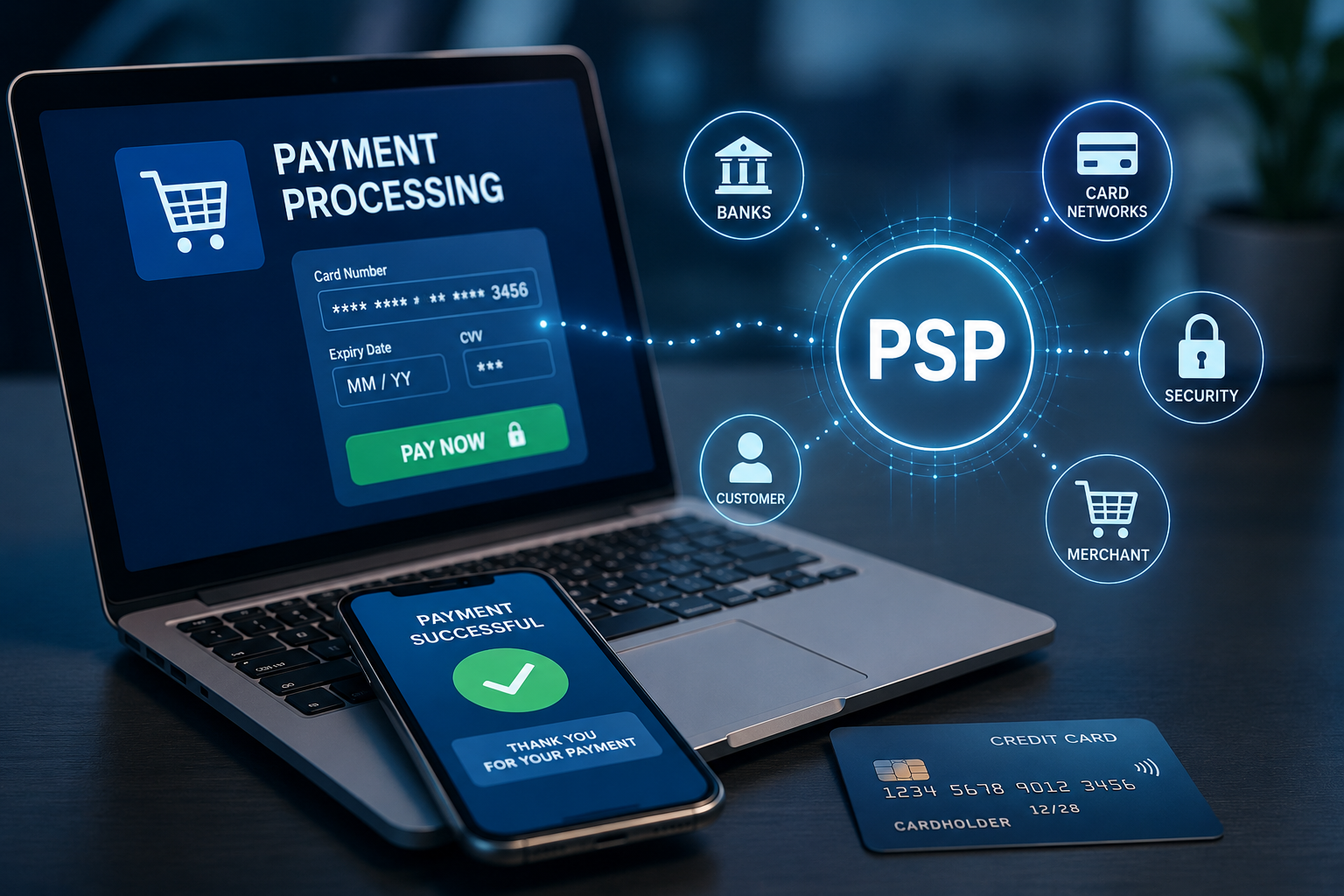
If you've ever tried to set up online payments for your business, you've probably come across the term "payment service provider" — or PSP. But what exactly is a PSP, how does it differ from a bank, and does your business actually need one?
This guide breaks it down clearly so you can make an informed decision.
What is a Payment Service Provider?
A payment service provider (PSP) is a company that enables businesses to accept electronic payments — including credit cards, debit cards, bank transfers, and mobile payments. PSPs act as the technical and commercial bridge between a merchant (you), the customer's bank, and the card networks such as Visa and Mastercard.
In simple terms: when a customer pays you online, the PSP handles everything that happens between the customer clicking "pay" and the money appearing in your account.
What Does a PSP Actually Do?
A PSP typically handles several functions at once:
Payment gateway — the technology that securely captures and transmits payment data from your website or app to the acquiring bank.
Merchant account — the holding account where funds sit after a transaction is authorised, before being settled into your business bank account.
Fraud and risk management — screening transactions for suspicious activity and managing chargebacks on your behalf.
Reporting and reconciliation — giving you a dashboard to track transactions, settlements, refunds, and disputes in real time.
Integration — connecting to your website, e-commerce platform, or app via API, hosted payment page, or plugin.
Some PSPs also provide the acquiring bank relationship directly (known as a payment facilitator model), while others work with a separate acquiring bank behind the scenes.
PSP vs Acquiring Bank — What's the Difference?
This is where many merchants get confused.
An acquiring bank is a licensed financial institution that processes card payments on behalf of merchants. It holds the merchant account and takes on the financial risk of processing your transactions.
A PSP is typically a technology layer that sits between you and the acquiring bank. It provides the payment gateway, the merchant interface, and often the merchant account — while the actual card processing happens through a partner acquiring bank.
Some PSPs are also licensed acquirers themselves. Others are not — they aggregate merchants under their own master merchant account (known as a payment facilitator or PayFac model).
The key difference for merchants: with a direct acquiring bank relationship, you have your own dedicated merchant account. With a PayFac-model PSP, you're sub-merchant under their account — which is faster to set up but gives you less control and lower thresholds for account termination.
Do You Need a PSP?
The short answer: if you want to accept card payments or online payments, yes — you need a PSP or an acquiring bank relationship.
Whether you go directly to an acquiring bank or through a PSP depends on your business size, volume, and risk profile:
You probably need a PSP if:
You're a small to medium business that needs to get set up quickly
You want a simple, all-in-one solution without managing multiple relationships
You're selling online and need a hosted checkout or plugin integration
Your monthly volume is under a few hundred thousand dirhams
You may need a direct acquiring bank relationship if:
You're processing high volumes (millions of dirhams per month)
You want lower per-transaction rates negotiated directly
You're in a regulated or high-risk industry where standard PSPs won't onboard you
You need specific settlement terms or currency arrangements
What to Look for in a PSP
Not all PSPs are equal. Here's what matters when choosing one for your business:
Supported payment methods — does it accept the cards and payment methods your customers actually use? For Moroccan merchants, CMI card acceptance is essential for domestic transactions.
Supported countries — not all PSPs operate in Morocco or support Moroccan-registered businesses. Stripe, for example, does not currently support Morocco-domiciled merchants. Always verify before applying.
Fees and pricing — look at the all-in merchant discount rate, monthly fees, setup costs, and chargeback fees. Since Bank Al-Maghrib capped domestic interchange at 0.65% in October 2024, domestic card processing has become more competitive.
Settlement speed — how quickly does money reach your account? Standard domestic settlement in Morocco is D+7 to D+14. Some PSPs settle slower.
Integration options — does it integrate with your platform? Most PSPs support WooCommerce, Shopify, and PrestaShop via plugins. Check before committing.
Support quality — can you reach someone when things go wrong? Payment issues need fast resolution. Assess the support offering before signing up.
Contract terms — watch for long lock-in periods, early termination fees, and rolling reserve requirements. High-risk merchants in particular should scrutinise these carefully.
PSPs Available to Moroccan Merchants
Following the liberalisation of Morocco's acquiring market in May 2025, Moroccan merchants now have more options than ever:
CMI — historically the dominant gateway, now repositioning as a neutral platform following the Competition Council ruling
Bank-owned acquiring subsidiaries — Attijari Payment, CIH Pay, Damane Cash, and others now offer direct merchant acquiring
Payzone (VPS) — an independent Moroccan PSP with fast onboarding and e-commerce plugins
PayTabs — a MENA-focused PSP that explicitly supports Morocco-domiciled merchants
Regional and international PSPs — available to some Moroccan businesses depending on volume, business model, and risk profile
The Problem with Finding the Right PSP
The challenge for most Moroccan merchants isn't understanding what a PSP is — it's finding the right one for their specific business.
The wrong PSP match leads to:
Application declines and wasted time
Account terminations after processing begins
Higher fees than necessary for your volume and risk profile
Poor support when disputes or settlement issues arise
This is where payment advisory services like KhlasPay come in. Rather than applying to PSPs blind, KhlasPay assesses your business model, volume, and risk profile and matches you with the PSP and acquiring bank best suited to your needs — managing the application and onboarding process on your behalf.
Final Thoughts
A payment service provider is an essential piece of infrastructure for any business accepting online payments. The right PSP makes payments invisible — customers pay, money arrives, everything works. The wrong PSP creates friction, delays, and risk.
For Moroccan merchants in particular, the landscape has changed significantly since 2024. More options exist, fees are more competitive, and the right advisory support can make the difference between a smooth setup and months of delays.
If you're not sure which PSP is right for your business, KhlasPay can help.
KhlasPay is a payment advisory and services platform helping merchants across Morocco, Africa, and Europe find and manage the right payment solutions for their business.