
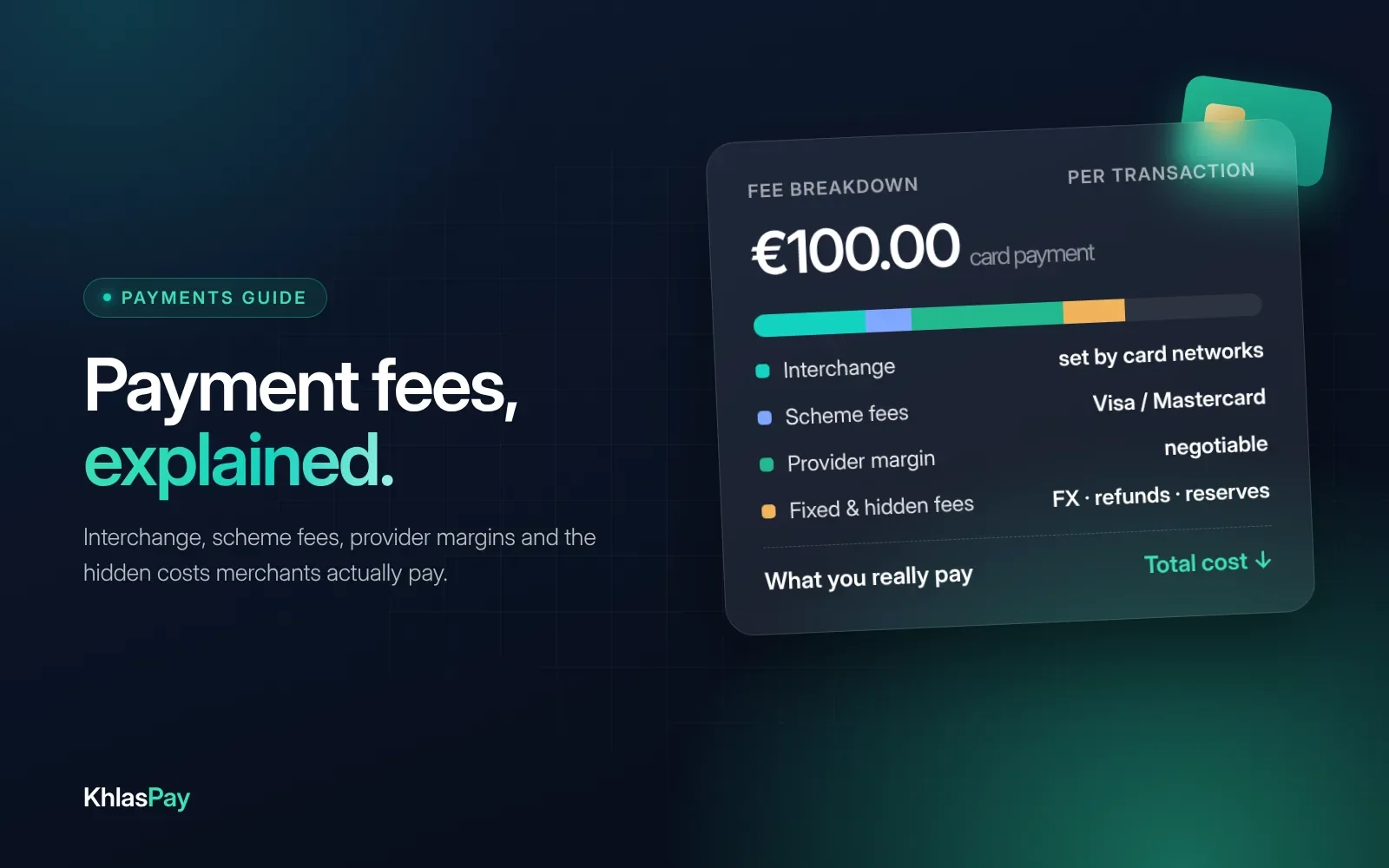
Breakdown of payment processing fees: interchange, scheme fees, provider margin and hidden costs
Most merchants know their "rate" — but very few know what they actually pay. A headline figure like 1.5% rarely tells the whole story once setup fees, monthly charges, refunds, chargebacks, currency conversion and rolling reserves are added in.
This guide breaks down every layer of a payment processing fee, explains the two main pricing models, and shows what has changed for merchants in Morocco, the EU and the UK in 2026 — so you can compare offers properly and know which questions to ask before you sign.
The Three Layers of Every Card Fee
Every card transaction fee is made of three parts. Only one of them is set by your provider — the other two are fixed by the card networks and, in many countries, by regulators.
| Layer | Who receives it | Who sets it | Negotiable? |
|---|---|---|---|
| Interchange | The customer's card-issuing bank | Visa / Mastercard, capped by regulators in many markets | No |
| Scheme fees | Visa, Mastercard and other card networks | The card networks | No |
| Acquirer / PSP margin | Your acquiring bank or payment provider | Your provider | Yes |
Interchange is the largest single cost on most transactions. It varies by card type (debit, credit, premium, commercial), by where the card was issued, and by whether the card was present or used online.
Scheme fees are smaller charges the card networks collect for using their rails — for authorisation, clearing and cross-border processing.
The acquirer or PSP margin is what your provider charges on top for the service: processing, settlement, fraud tools, support and risk. This is the only layer where shopping around makes a real difference.
Blended Pricing vs Interchange++
Providers package those three layers in one of two ways. Which one suits you depends mainly on your volume and how predictable your costs need to be.
| Blended (flat rate) | Interchange++ (IC++) | |
|---|---|---|
| How it works | One fixed percentage covers everything | Interchange and scheme fees passed through at cost, plus a fixed provider margin |
| Example | 1.9% on every card | Actual interchange + actual scheme fee + 0.3% |
| Best for | Smaller merchants who want simple, predictable costs | Growing and high-volume merchants who want the lowest true cost |
| Watch out for | You may overpay on cheap debit cards to subsidise expensive ones | Statements are more complex and costs vary month to month |
As a rule of thumb, blended pricing is simpler to start with, while IC++ usually becomes cheaper once monthly volume grows — because you stop paying a premium on low-cost cards.
The Fees Beyond the Percentage
The transaction rate is only part of the bill. These are the charges that most often catch merchants out — always ask for each one in writing.
| Fee | What it is | What to check |
|---|---|---|
| Setup / account opening | One-off fee to open your merchant or payment account | Whether it is refundable if you are declined |
| Monthly account fee | Fixed charge regardless of volume | Whether a minimum monthly volume applies |
| Per-transaction fixed fee | A flat amount added to each transaction (e.g. €0.20) | How it affects small-ticket sales |
| Refund fee | Charged when you refund a customer | Whether the original processing fee is returned |
| Chargeback fee | Charged each time a customer disputes a payment | The fee per dispute, and whether it applies if you win |
| Currency conversion (FX) | Margin added when a payment is converted | The margin over the mid-market rate |
| Rolling reserve | A percentage of revenue held back as security | The percentage, how long it is held, and any cap |
| Settlement / payout fee | Charged to move funds to your bank account | How often payouts happen and the cost per payout |
| Early termination | Penalty for leaving before the contract ends | Contract length and notice period |
A provider offering a low headline rate can easily cost more overall if its chargeback fee, FX margin or reserve terms are worse. Always compare the total cost on a realistic month of your own transactions — not just the percentage.
What Merchants Pay in Morocco, the EU and the UK
Where your business and your customers are located has a big effect on the interchange layer — and 2026 brought real changes.
| Market | Consumer card interchange | What changed recently |
|---|---|---|
| Morocco (domestic cards) | Capped at 0.50% excl. tax; 0.15% for e-Gov and neighbourhood shops | Cut from 0.65% to 0.50% from 1 October 2026 |
| EU / EEA | Capped at 0.2% debit, 0.3% credit | Stable under the EU Interchange Fee Regulation |
| UK ↔ EEA online (card-not-present) | 1.15% debit, 1.5% credit | No cap yet — the UK regulator is still working on one |
Morocco. Bank Al-Maghrib cut the domestic interchange cap from 0.65% to 0.50% (excluding tax) from 1 October 2026, with a lower 0.15% cap for e-Gov and neighbourhood merchants. Interchange is only part of what a merchant pays — the acquirer still adds its own margin on top. Merchants are also forbidden from passing card fees on to customers, and acquirers must now spell out every fee in their merchant contracts.
UK–EEA. After Brexit, Visa and Mastercard raised interchange on online UK–EEA payments from 0.2% and 0.3% to 1.15% and 1.5% — roughly five times higher. The Payment Systems Regulator found these increases cost UK businesses £150–200 million a year and is developing a price cap, but no rate or start date has been set. If you sell online across the UK–EU border, this is a fee to watch on your statements.
What Pushes Your Rate Up or Down
Two merchants on the same provider can pay very different rates. These are the factors acquirers weigh when pricing your account:
- Monthly volume — higher, steadier volume usually earns a lower margin.
- Average transaction value — very small tickets suffer most from fixed per-transaction fees.
- Card mix — debit cards cost less than credit, premium or commercial cards.
- Customer location — domestic cards are cheaper than foreign or cross-border cards.
- Online vs in person — card-not-present payments carry more fraud risk and cost more.
- Chargeback and refund history — a high dispute rate leads to higher fees and reserves.
- Industry — sectors such as travel, gaming or subscriptions are priced for higher risk.
- Business track record — new businesses with no processing history often start on higher rates.
The good news: several of these improve over time. A clean processing history and lower chargeback rate are strong grounds to renegotiate after six to twelve months.
How to Lower Your Processing Costs
- Compare total cost, not headline rate. Run three months of your real transactions through each quote.
- Move to interchange++ as you grow. Once volume is steady, IC++ usually beats a blended rate.
- Reduce chargebacks. Clear billing descriptors, fast refunds and good customer service cut disputes — and the fees and reserves that come with them.
- Settle in the right currency. Avoid unnecessary conversions by settling in the currency you sell in where possible.
- Renegotiate on evidence. Use a clean six-to-twelve-month history to ask for a lower margin or a smaller reserve.
- Review your statement every month. Fees creep in. Moroccan acquirers are now required to list every fee in your contract, so check your statement against it.
Questions to Ask Before You Sign
- What is the total cost on my expected monthly volume and card mix?
- Is this blended pricing or interchange++?
- What are the chargeback, refund and FX fees?
- Is there a rolling reserve — what percentage, for how long, and is it capped?
- How often do I get paid, and is there a payout fee?
- What is the minimum contract term and the cost of leaving early?
Final Thoughts
Payment processing fees are not one number — they are interchange, scheme fees and your provider's margin, plus a set of fixed charges that can matter just as much. Once you can see each layer, comparing offers becomes far simpler and negotiating becomes far easier.
The market is also moving in merchants' favour: Morocco's interchange cap fell to 0.50% in October 2026, and the UK regulator is working towards a cap on cross-border online fees.
KhlasPay publishes its own fees openly by merchant profile — see our pricing page for the full breakdown.
Not Sure What You're Really Paying?
Send us your current statement and our team will walk you through every fee.
Talk to a Payment ExpertKhlasPay is a payment advisory and services platform helping merchants across Morocco, Africa and Europe find and manage the right payment solutions. KhlasPay is not a bank or payment institution; processing services are provided by licensed partners. This article is for general information and is not financial or legal advice.
